

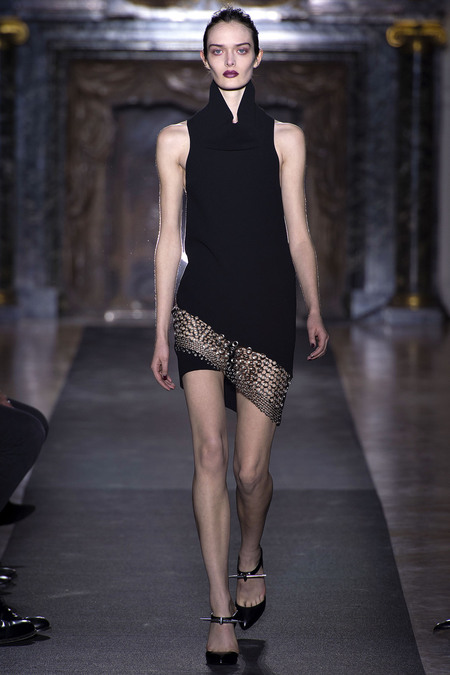
Overlapping with the last day of shows in Milan, the first day of Paris Fashion Week featured collections from primarily younger talents and smaller labels, the most promising of which was Anthony Vaccarello. His Fall collection was as sexy as always, but this time it left a little more to the imagination. Semi-fitted trouser suits with open shirts had an androgynous sex appeal, while loose blouses and angora knits softened fitted leather minis. Industrial metal hardware was constructed as mesh, used to best effect when used simply as raglan sleeves or narrow panels, straying into tasteless territory on gowns featuring Vaccarello's signature thigh-high slit. Wrap-around styles with complicated leather straps were sexy yet chic- a combination we hope the designer continues to perfect.


The big guns joined the show on day two, with Dries Van Noten presenting a collection that, for me, was heaven on earth. Dries has always been an expert at creating clothes that appeal to those with feminine and masculine tastes, this season inspired by the 1935 musical comedy Top Hat, with stars Ginger Rogers and Fred Astaire offering contradictions for the designer to mix. Fred was there from the start, in tailored grey trousers, navy peacoat and collegiate stripes, when Ginger creeped in with statement necklaces, crystals, fringing and finally, feathers. A lot of the femininity has a masculine touch- some fringing was in fact frayed striped silk reminiscent of tie fabric, embellished dress had low waists, skirts were paired with mannish shirts and both oftentimes came worn over trousers. The feather embellishment replaced the fall trend for fur, starting off dainty, dotted with diamante on outerwear, developing into colourful pink and yellow evening wear, before growing in volume and winding itself around the body. Embroidery was another decorative element, bright yellow bloom covered sides of utilitarian shirting or marked the waists of pinstripe blazers. Dries gave us what we didn't know we wanted; inspiring, special, yet wearable pieces that begged the question why no one had thought of all this before?


Marco Zahini offered another variation of masculine and feminine over at Rochas, presenting forties and fifties silhouettes in Prince of Whales checks, tweeds and heavy wools. His palette was much paler, featuring duck egg blue, dove grey, moss green and fawn, with dashes of chartreuse and darker grey towards the end. The colours aged the collection, while the weight of the fabrics lessened its wearability- swirling circle skirts in thick wool could hardly be described as practical. Zahini obviously tried to take things away from being too 'pretty', accessorising with inverted heeled shoes that slowed the models, ballerina flats with heavy soles, as well as his take on the trend of Celine's rolled-up clutch, that unfortunately was so small that I wondered what you could possibly put in there. I will applaud Zahini on his use of faux fur that looked every bit as luxurious as other designers' offering, but without the guilt, something particularly important with the huge trend for animal skin in the fall shows so far.


From the forties to the future, where Nicola Formichetti of Mugler touched on the sixties, nineties and beyond in a collection inspired by air travel and the idea of time travel. The starting looks featured voluminous yet sculptural shapes that were strong on top, with skirts wrinkling where they shouldn't, and the lining slipping below the hem on the opening look. There were experimental construction ideas in luxurious fabrics that would have made for interesting development but creativity faltered in the dresses that morphed into a disjointed style of awkwardly-draed silks atop 80's printed jersey. I would venture to attribute the opening looks to womenswear designer Sébastien Peigné, who perhaps looked back on his time working alongside Nicolas Ghesquire at Balenciaga, making me wonder if the odd juxtaposition of styles in the 27 looks is down to two designers sharing the bow at the end of the show.


The third day of shows in Paris began with the most anticipated show of the season- Alexander Wang's debut at Balenciaga. Study of the archives was evident in the curved shoulders and rounded hips that dominated the silhouette, its sculptural effect strengthened by the power of a monochrome colour palette. The cut was simple and intelligent like that of Cristobal Balenciaga, but what many seem to have forgotten in the Wan hysteria, is that the celebration of this construction in the heyday of its founder was that it was new, unlike fashions before it. Wang used fabrics to bring ingenuity to his catwalk, where painting ribbed knits, burnt out velvet and print mimicked marble. Knotted silver wrapped around models' wrists, waists and ankles, in what looked a lot like the barbed wire jewellery and belts from Rodarte's Fall collection. It was a beautiful collection nonetheless, but a more timid debut than I expected, and one wonders if Wang intentionally didn't push the boat out in an effort to capture simplicity, or simply because he couldn't rise to the ultimate challenge that comes with taking over a Paris fashion house- going outside his comfort zone.


A designer mixing things up is Guillaume Henry at Carven, who gave gave his signature kooky prettiness a graphic edge with a heavy dose of zebra print this season. It came as print and jacquard, some incorporating rubber like the show invite, with print also appearing as a spotted fawn- an animal print I don't think we've seen before. The 1950's, off-the-shoulder, fitted dresses that walked down the Prada runway were seen here too, with the glowing highlight print that could be mistaken for blurred florals also looking quite Prada-esque. Fitted knits in criss-cross patterns and oversized outerwear in fuzzy pastels will be the sure sellers in another quirky but wearable collection.


This month saw Irish designer, Sharon Wauchob, present her eighth show at Paris Fashion Week. She presented a collection of easy elegance, its inspiration of ballet dancers referenced not literally, but in the quiet control and delicate touches. Waists were low, skirts and trousers long and loose, paired with slashed necklines or tops with fabric casually tied around the waist, like ballet dancers after practice. Light wools, gleaming silks, fine fringing and delicate lace lent to gliding movement, offset by textured wools and heavy furs, with dainty gold beading and intricate embroidery adding some finer details.


Rick Owens' menswear collection last month saw a softer touch, which seeped into his womenswear offering, something you wouldn't guess from the theme of 'Battle-scarred Heroism' that Owens' referenced. Like their male counterparts, the models' hair was windswept across their faces as they emerged from billowing steam on the runway, stomping on leather boots with needle-sharp stiletto heels, a change from the label's usual chunky soles. Coats were long like the t-shirts and tunics they were layered over, many donning relatively simple sheepskin collars, detail creeping in with the duffel coats and their tribal closures. Owens' study of traditional basket weaving took to leather panels, connected with leather stitching, growing in size until they looked like knots, then becoming finer in strands woven through coats purely for aesthetic reasons. The Japanese influence was more apparent in the graphic black and white looks, with fawn being the only other colour, in what was a refined yet very much signature Rick Owens collection.


Ballet dancers reappeared as inspiration for Peter Copping's romantic collection for Nina Ricci. The dancers' ways of layering garments could be seen in a jacket's collar tied like sleeves around a waist, coats over leotards for a rather risque walk home from dance class. The models were as slender as the designer's muse, which led to some bustier shapes looking a little loose and the drape over the bust often seemed a bit messy. Save for that, it was a beautiful collection- Copping brought sophistication to the girly touches with luxurious fabrics- a parka edged in fur, evening dresses belted with a string of ostrich feathers, hems dancing with ruffles of pleats and lace.


For Fall, Alber Elbaz tossed themes and inspirations aside and looked to why he does what he does, why fashion exists. To be worn and to be enjoyed, of course. The answer created a collection of beautifully-made clothes, accessorized with fun and rebellion- almost literally with chunky gold chains with medallions creaming HELP! and COOL. Garments for every occasion walked down the runway- a perfectly-fitted bustier cocktail dress, tartan skirt suits, sturdy leather bags, ruffled blouses, tailored trousers, glamorous gowns, trusty leather brogues and glittering dancing shoes. Quality set them apart, an issue clearly in Elbaz's mind in his use of exposed seams, flattering silhouettes and luxurious fabrics. Elbaz's playful personality gave the whole collection character- the oversized bug brooches, chiffon blooms, costume jewellery, all coming together to form a winning combination.


Meanwhile, over at Roland Mouret, fun was off the menu, the designer looking to the steely strength of Parisian women as inspiration. The clothing was certainly well-fitted, how the French like it, but I thought the bold colour blocking a little garish to be thought of as chic. Zebra knit jacquard crept in, followed by leopard as shoulders widened- perhaps referencing Mouret's other inspiration of Catherine Deneuve in 1983 vampire movie The Hunger, but there was little evidence of Deneuve's style and elegance here.


The elegance Christian Dior was known for was resurrected on the Dior catwalk, touched with the growing influence of Raf Simon's more eclectic taste. For his couture collection, the two designers' love of gardens was the inspiration, and this time Simons looked to their shared interest in art, using Andy Warhol's illustrations throughout the collection. They appeared on on bags and dresses, placed haphazardly on the latter like a scrapbook or mood board, described by Simons as 'memory dresses'. He used his artistic eye to turn Dior's beloved classic houndstooth into a graphic print, as well as blowing traditional knit up in proportion for dramatic ruffles. The unexpected layering of garments in his couture collection continued here, with waistcoats over bustier dresses, moulded together by the curved hips of both. Simons' mastery of couture shapes and masterful drape is something that sets him aside from the other designers that have recently taken over great Parisian fashion houses like Balenciaga. He is accomplished at all elements of fashion design, skilful at putting his own spin on the label's legacy and takes advantage of the skilled team he has at his disposal, and his Fall collection was a testament to that.


Another house that has lost its founder is Maison Martin Margiela, its collection designed by an anonymous team, secretive like the man they seek to emulate. The show started off with an ode to Margiela's take on tailoring- slightly surreal with oversized cuffs like the sleeves were growing off the wrist, necklines knotted like ties. it was interesting to watch the development unfold but it felt a little overworked in quantity- the maroon pinstriped looks needn't have been shown. Messy knit atop fine mesh and organza followed, ranging from pretty in red and pink to abstract curves directing their way around the torso, to purely messy. The seemingly unconnected range of concepts continued floor length dresses emblazoned with 'defile' down the side, but with all of the ideas floating around, it was hard to interpret what the collection meant as a whole.


Examining strength and fragility inspired Haider Ackermann's collection this season. Designer's refreshed respect for traditional fabrics was evident, with heavy wools, buttery leather, silk velvet and linens all present, given an earthy tone with brown python, exposed seams and frayed edges. Ackermann's skill in construction was more classical and wearable this season, seen in elegant draped necklines, jackets falling easily off the shoulder, blouses falling open to the navel- all worn with an air of nonchalance. Leather belts tightly wrapped around the waist created a flattering silhouette but many of the oversized outerwear pieces were simply unflattering. Fur was used for the first time, in weaker pieces that must have been created purely to attract a new customer, but Ackermann's thought for commercial appeal applied to the whole collection, making it one of his most wearable yet.


The big guns joined the show on day two, with Dries Van Noten presenting a collection that, for me, was heaven on earth. Dries has always been an expert at creating clothes that appeal to those with feminine and masculine tastes, this season inspired by the 1935 musical comedy Top Hat, with stars Ginger Rogers and Fred Astaire offering contradictions for the designer to mix. Fred was there from the start, in tailored grey trousers, navy peacoat and collegiate stripes, when Ginger creeped in with statement necklaces, crystals, fringing and finally, feathers. A lot of the femininity has a masculine touch- some fringing was in fact frayed striped silk reminiscent of tie fabric, embellished dress had low waists, skirts were paired with mannish shirts and both oftentimes came worn over trousers. The feather embellishment replaced the fall trend for fur, starting off dainty, dotted with diamante on outerwear, developing into colourful pink and yellow evening wear, before growing in volume and winding itself around the body. Embroidery was another decorative element, bright yellow bloom covered sides of utilitarian shirting or marked the waists of pinstripe blazers. Dries gave us what we didn't know we wanted; inspiring, special, yet wearable pieces that begged the question why no one had thought of all this before?


Marco Zahini offered another variation of masculine and feminine over at Rochas, presenting forties and fifties silhouettes in Prince of Whales checks, tweeds and heavy wools. His palette was much paler, featuring duck egg blue, dove grey, moss green and fawn, with dashes of chartreuse and darker grey towards the end. The colours aged the collection, while the weight of the fabrics lessened its wearability- swirling circle skirts in thick wool could hardly be described as practical. Zahini obviously tried to take things away from being too 'pretty', accessorising with inverted heeled shoes that slowed the models, ballerina flats with heavy soles, as well as his take on the trend of Celine's rolled-up clutch, that unfortunately was so small that I wondered what you could possibly put in there. I will applaud Zahini on his use of faux fur that looked every bit as luxurious as other designers' offering, but without the guilt, something particularly important with the huge trend for animal skin in the fall shows so far.


From the forties to the future, where Nicola Formichetti of Mugler touched on the sixties, nineties and beyond in a collection inspired by air travel and the idea of time travel. The starting looks featured voluminous yet sculptural shapes that were strong on top, with skirts wrinkling where they shouldn't, and the lining slipping below the hem on the opening look. There were experimental construction ideas in luxurious fabrics that would have made for interesting development but creativity faltered in the dresses that morphed into a disjointed style of awkwardly-draed silks atop 80's printed jersey. I would venture to attribute the opening looks to womenswear designer Sébastien Peigné, who perhaps looked back on his time working alongside Nicolas Ghesquire at Balenciaga, making me wonder if the odd juxtaposition of styles in the 27 looks is down to two designers sharing the bow at the end of the show.
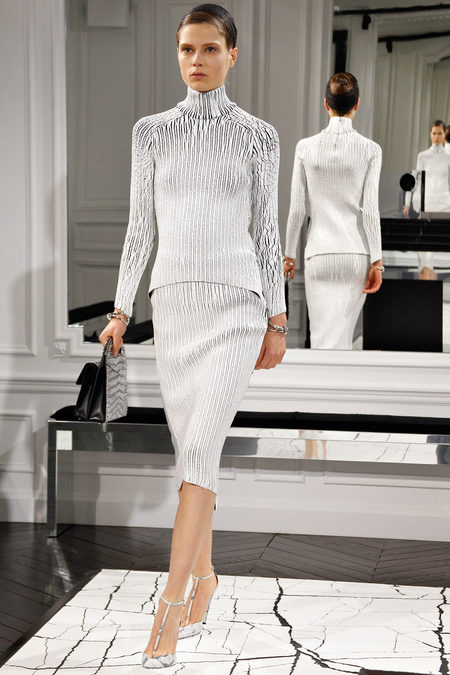


The third day of shows in Paris began with the most anticipated show of the season- Alexander Wang's debut at Balenciaga. Study of the archives was evident in the curved shoulders and rounded hips that dominated the silhouette, its sculptural effect strengthened by the power of a monochrome colour palette. The cut was simple and intelligent like that of Cristobal Balenciaga, but what many seem to have forgotten in the Wan hysteria, is that the celebration of this construction in the heyday of its founder was that it was new, unlike fashions before it. Wang used fabrics to bring ingenuity to his catwalk, where painting ribbed knits, burnt out velvet and print mimicked marble. Knotted silver wrapped around models' wrists, waists and ankles, in what looked a lot like the barbed wire jewellery and belts from Rodarte's Fall collection. It was a beautiful collection nonetheless, but a more timid debut than I expected, and one wonders if Wang intentionally didn't push the boat out in an effort to capture simplicity, or simply because he couldn't rise to the ultimate challenge that comes with taking over a Paris fashion house- going outside his comfort zone.


A designer mixing things up is Guillaume Henry at Carven, who gave gave his signature kooky prettiness a graphic edge with a heavy dose of zebra print this season. It came as print and jacquard, some incorporating rubber like the show invite, with print also appearing as a spotted fawn- an animal print I don't think we've seen before. The 1950's, off-the-shoulder, fitted dresses that walked down the Prada runway were seen here too, with the glowing highlight print that could be mistaken for blurred florals also looking quite Prada-esque. Fitted knits in criss-cross patterns and oversized outerwear in fuzzy pastels will be the sure sellers in another quirky but wearable collection.


This month saw Irish designer, Sharon Wauchob, present her eighth show at Paris Fashion Week. She presented a collection of easy elegance, its inspiration of ballet dancers referenced not literally, but in the quiet control and delicate touches. Waists were low, skirts and trousers long and loose, paired with slashed necklines or tops with fabric casually tied around the waist, like ballet dancers after practice. Light wools, gleaming silks, fine fringing and delicate lace lent to gliding movement, offset by textured wools and heavy furs, with dainty gold beading and intricate embroidery adding some finer details.


Rick Owens' menswear collection last month saw a softer touch, which seeped into his womenswear offering, something you wouldn't guess from the theme of 'Battle-scarred Heroism' that Owens' referenced. Like their male counterparts, the models' hair was windswept across their faces as they emerged from billowing steam on the runway, stomping on leather boots with needle-sharp stiletto heels, a change from the label's usual chunky soles. Coats were long like the t-shirts and tunics they were layered over, many donning relatively simple sheepskin collars, detail creeping in with the duffel coats and their tribal closures. Owens' study of traditional basket weaving took to leather panels, connected with leather stitching, growing in size until they looked like knots, then becoming finer in strands woven through coats purely for aesthetic reasons. The Japanese influence was more apparent in the graphic black and white looks, with fawn being the only other colour, in what was a refined yet very much signature Rick Owens collection.


Ballet dancers reappeared as inspiration for Peter Copping's romantic collection for Nina Ricci. The dancers' ways of layering garments could be seen in a jacket's collar tied like sleeves around a waist, coats over leotards for a rather risque walk home from dance class. The models were as slender as the designer's muse, which led to some bustier shapes looking a little loose and the drape over the bust often seemed a bit messy. Save for that, it was a beautiful collection- Copping brought sophistication to the girly touches with luxurious fabrics- a parka edged in fur, evening dresses belted with a string of ostrich feathers, hems dancing with ruffles of pleats and lace.


For Fall, Alber Elbaz tossed themes and inspirations aside and looked to why he does what he does, why fashion exists. To be worn and to be enjoyed, of course. The answer created a collection of beautifully-made clothes, accessorized with fun and rebellion- almost literally with chunky gold chains with medallions creaming HELP! and COOL. Garments for every occasion walked down the runway- a perfectly-fitted bustier cocktail dress, tartan skirt suits, sturdy leather bags, ruffled blouses, tailored trousers, glamorous gowns, trusty leather brogues and glittering dancing shoes. Quality set them apart, an issue clearly in Elbaz's mind in his use of exposed seams, flattering silhouettes and luxurious fabrics. Elbaz's playful personality gave the whole collection character- the oversized bug brooches, chiffon blooms, costume jewellery, all coming together to form a winning combination.


Meanwhile, over at Roland Mouret, fun was off the menu, the designer looking to the steely strength of Parisian women as inspiration. The clothing was certainly well-fitted, how the French like it, but I thought the bold colour blocking a little garish to be thought of as chic. Zebra knit jacquard crept in, followed by leopard as shoulders widened- perhaps referencing Mouret's other inspiration of Catherine Deneuve in 1983 vampire movie The Hunger, but there was little evidence of Deneuve's style and elegance here.


The elegance Christian Dior was known for was resurrected on the Dior catwalk, touched with the growing influence of Raf Simon's more eclectic taste. For his couture collection, the two designers' love of gardens was the inspiration, and this time Simons looked to their shared interest in art, using Andy Warhol's illustrations throughout the collection. They appeared on on bags and dresses, placed haphazardly on the latter like a scrapbook or mood board, described by Simons as 'memory dresses'. He used his artistic eye to turn Dior's beloved classic houndstooth into a graphic print, as well as blowing traditional knit up in proportion for dramatic ruffles. The unexpected layering of garments in his couture collection continued here, with waistcoats over bustier dresses, moulded together by the curved hips of both. Simons' mastery of couture shapes and masterful drape is something that sets him aside from the other designers that have recently taken over great Parisian fashion houses like Balenciaga. He is accomplished at all elements of fashion design, skilful at putting his own spin on the label's legacy and takes advantage of the skilled team he has at his disposal, and his Fall collection was a testament to that.


Another house that has lost its founder is Maison Martin Margiela, its collection designed by an anonymous team, secretive like the man they seek to emulate. The show started off with an ode to Margiela's take on tailoring- slightly surreal with oversized cuffs like the sleeves were growing off the wrist, necklines knotted like ties. it was interesting to watch the development unfold but it felt a little overworked in quantity- the maroon pinstriped looks needn't have been shown. Messy knit atop fine mesh and organza followed, ranging from pretty in red and pink to abstract curves directing their way around the torso, to purely messy. The seemingly unconnected range of concepts continued floor length dresses emblazoned with 'defile' down the side, but with all of the ideas floating around, it was hard to interpret what the collection meant as a whole.


Examining strength and fragility inspired Haider Ackermann's collection this season. Designer's refreshed respect for traditional fabrics was evident, with heavy wools, buttery leather, silk velvet and linens all present, given an earthy tone with brown python, exposed seams and frayed edges. Ackermann's skill in construction was more classical and wearable this season, seen in elegant draped necklines, jackets falling easily off the shoulder, blouses falling open to the navel- all worn with an air of nonchalance. Leather belts tightly wrapped around the waist created a flattering silhouette but many of the oversized outerwear pieces were simply unflattering. Fur was used for the first time, in weaker pieces that must have been created purely to attract a new customer, but Ackermann's thought for commercial appeal applied to the whole collection, making it one of his most wearable yet.


