Wednesday, 26 February 2014

NYFW FALL 2014: The Highlights

New York as a fashion capital is often looked down on by the snobbish elite for it's commercial qualities and financial success. Having given up on the romantic notions of tortured artists and unpaid internships long ago, New York hosts some of my favourite shows- I having complete respect for designers that have mastered the tricky balance of creativity and wearability. I will admit however, that like every city's fashion week schedule, you have to sift through many presentations that are all commercial and no creative, coming from brands both established and little-known.


The first show to take my attention was Helmut Lang, the tomato red of its collection alerting the senses. Despite the dramatic contrasts in a colour palette of scarlet, camel, cream, grey and black, it was texture that interested designers Nicole and Michael Colovos this season. Tailored pieces with neat necklines and straight waists came in crinkled wools, fluffy knit peaking through cuffs and collars, slipping over skirts and trousers of slinky silks and shining leathers. Architectured necklines and seamlines exaggerated by topstitching kept loose shapes in check, the soft fabrics and an abundance of naked skin carrying a silhouette larger than the trademark Lang away from being unflattering.


A focus on fabrics continued at Altuzarra, where double-faced cashmeres spoke to New York's classic side in shawl-collared belted coats, earning fashion points in a navy and electric blue combination, later followed by a muted green paired with shocking pink. Altuzarra's interest in handcrafts, made a welcome return after an absence in Spring, in the form of hand-loomed tapestries in yarns of different thickness and colour, inspired by textile artist Sheila Hicks. Fluid silks with daring slits and bandeau cocktail dresses with peekaboo linings supported the sexy, sophisticated appeal that Altuzarra has become known for, while deep-pile fleece jackets spoke of the same sumptuousness that one of Michael Kor's furs might warrant, creating what Altuzarra described as a 'different type of luxury'.


Climbing down a few rungs of the catwalk ladder, I next look at a much younger label- Delpozo, a who only made its New York debut one year ago. Now with a Milan store to its name, its developing something of a cult following, gaining attention for blurring the lines between couture and RTW- something that's becoming a bit of a trend. Designer Josep Font has a talent for combining strong shapes with dreamy femininity, this season inspired by 1960's sci-fi novel Logan's Run and the purist forms of Italian artist Duilio Barnabe. Delicate and strong creations followed- pale blush felt folded gently into a statuesque cape, light as a feather knits cascading over invisible petticoats of stiff organza, pale pink leather cut into seductive necklines and elegant A-line skirts, and delicate sprinklings of crystals over cocoon shapes worn like armour. The predominantly long lengths were reminiscent of the thirties, with the round panels in block colours giving reference to Bauhaus paintings- creating a retro feel, yet these pieces could easily be imagined on today's modern woman. 


Fast-forward to the Prabal Gurung show, where the designer looked to fashion's other long-serving inspiration of travel, specifically Gurung's trip to the Himalayan territory of Mustang. The obvious references were there- shearling, feathers and blanket knits, but the mash up with sportswear influences gave it individuality. Waffle and cable knits merged, layered over wispy chiffon, feathers flounced from underneath twists of satin, primitive prints graced tailored shirts, patchwork coats came in fine furs. Drape wound its way into tailored suiting, with the flashes of skin looking a little like Anthony Vacarello, the textured swathes a little Altuzarra for Spring 2013. The technique look accomplished in classic chiffon, but the more structured satin looked a little tortured under strain- a bit of an experiment gone wrong.


Creative thinking with more refined results shaped The Row this season, where quietly dramatic shapes in awesomely luxe materials said a lot with few words. First came 900 gram cashmere hand knits- the already obvious cozy factor blown up by an oversized cowl neck sweater and  sweeping cape worn as a skirt. Volume continued in trapeze shapes, full skirts, kimono coats and blankets cascading over shoulders. Texture was key to interest but without embellishment- a black jacquard mimicked the sheens and swirls of ponyskin, fringed scarves broke the monotony of looks in just one fabric, another pale jacquard looked like abstract lace from afar, with leather, crocodile and ostrich skins adding to the pared-back luxury. Brogues bEnzo Bonafè, a mens shoe brand known for its high quality craftsmanship and traditional techniques, were the perfect finishing touch.


Another brand based on its luxurious aesthetics, albeit with more obvious appeal, is Victoria Beckham. Her take on boyish femininity was more elegant than last season- long, loose, double-breasted, enveloping the body like how one borrowed from your boy might fit, closed by a chunky gold chain. The fit and chain defined most of the looks, the repetition taking away from the charm somewhat, in a mostly monochrome colour palette broken by the occasional scarlet. A Picasso-like print drifted in and out, sometimes in pleats. Fur trimmed one look, ruffles adorning a few others, the fifth look came in a striking tweed never to be seen again, and the show finished with a lone gown. There were interesting and covetable looks no doubt, but it read like a story unfinished or missing vital chapters.


A collection not lacking in development was 3.1 Philip Lim, which showed 42 looks. Inspired by a vague muse, 'Soleil- a fun and culturally curious woman', it featured every colour under the sun- pastel violet, deep burgundies, burnt orange,and the more classic cream, grey and black. Pointed shirt collars and wide-legged trousers nodded to the 1930's, floral print panels gave a 1950's touch to otherwise black cocktail dresses, while clutches embossed with 'CASH', seatbelt buckled belts and statement footwear brought the noughties edge. The trend of panelled furs and sheepskins continued, as did ruffles- this time in knitwear, and the generally relaxed, boxy silhouettes sat well alongside the other Fall shows. The more experimental pieces, like a bizarrely oversized trenchcoat and panelled suede dress with jumpsuit details, were clearly out of Lim's comfort zone, and made one wonder if he would have benefitted from editing such an extensive collection.


Editing and self restraint is something of a problem for the Mulleavy sisters when designing for their label Rodarte. Their embrace of handcrafts and boundless imagination was what got fashion's attention, but it is often their downfall, when pieces begin to look like college projects or customising efforts gone wrong. This season's trip down memory lane through the dream items in children's dressing up boxes had all the makings of a stellar Rodarte collection, and it almost made it. The favourite of many a childrenswear designers, smocking, began the theme in chiffon eveningwear, the tucks studded with tiny rhinestones. Eighties off-the-shoulder numbers layered over turtlenecks offered a more wearable form of nostalgia, whereas the function and inspiration of coats without shoulders was less obvious. Giant glitter parkas with contrast shearling collars were tributes to the designers ability to give us what we didn't know we wanted, with sparkle on most of the pieces inviting girly screams, as did the bow-tied sandals, crystal-dotted socks, retro specs and metallic lips. The patchwork gowns brought Molly Ringwald's amateur prom dress creations to mind, but in shades of green, grey and orange, there was no Pretty or Pink appeal. Gowns with Star Wars stills down the side were both kooky and cool, perfect for some red carpet walker with a sense of humour. 


Humour is something Marc Jacobs has never been short of, and the recent appointment of Katie Hiller and Luella Bartley as creative and design directors of his diffusion brand Marc by Marc, got people wondering how much of the Marc we know and love they would hold on to. It turns out, they bottled the true essence of the man for their debut collection and returned to the rebellious attitude that made him famous in 1992 when he presented the Grunge collection for Perry Ellis, and subsequently got fired for. The first model stomped down the runway in snowboots emblazoned with MBMJ (the new name for the line), scholarly shirt tucked into loose trousers and an abstract obi belt, accessorised with tight plaits and a single, defiant teardrop. The next girl said rebellion louder- the word itself stamped down along the scuba zip of her glistening black dress, followed by another in pleated grey dungarees worn over a shirt in Denis the Menace's colours of black and red. The message got louder- BMX slogans slapped over almost every piece, checks blown to cartoonish scale, giant bows took over shoulders, tulle skirts were shorn into uneven layers, scarves pulled high like ninjas. This attitude was not simply teenage- tailored jackets with bold undercollars, waffle knits, and classic shirting, offered pieces for the more conformist customer- because as we know, this new direction comes at the time of a major IPO for the company.


If MBMJ's muse is a loud, rebellious school girl, the Marc Jacobs customer is a mature woman of few, yet powerful words. The show started with simple shapes- tank dresses, leggings, tunics and straight legged trousers in muted tones of beige, brown, blue and oatmeal. So far, so subtle, but with the first twenty looks drumming the message home, we almost stopped listening. Enter texture. Fur filled the hoods of voluminous bomber jackets, crept down arms and up legs through the lining of over-the-knee boots. Tunic dresses began to grow longer and sider, 70s style, as sequins entered the game via ruffled, scoop necked tanks. Jacobs' playful side dabbled in dip-dyed furs, a single floral lace number and sparkling sequin gowns in swooping prints. The gentle wave pattern developed into more literal prints, becoming three dimensional in tonal organza ruffles. Despite the surprising simplicity of the collection, the loose shapes, long lengths and tonal colours created a familiar kookiness, unfortunately partly due to the unflattering nature of the garments. Perhaps in the run up to the IPO Jacobs wanted to show a softer, more restrained side for a wider customer base, but lost desirability in the process.


Tuesday, 25 February 2014

The Return of Wes Anderson


I find it hard to believe it's been eight months since I last wrote a blog post. After taking on quite an intense placement last year, I found I had very little time to write, and even less time to pursue the interests that I like to write about. All I could have offered was secondhand reports on things I'd read online- sort of like pass-the-parcel with a not-so-surprising gift unveiled at the end. So, after a return to my 'read everything, see everything' habits, I feel it's time I got back into the blogging game, with a post on another comeback- that of Wes Anderson, and his much anticipated creation, The Grand Budapest Hotel.

 Winner of the Grand Jury Prize at the Berlin film festival, it is said to be one of Wes' best yet, although we have to wait until March 7th to judge for ourselves. To ease this painful test of our patience, the movie's soundtrack is streaming in its entirety online at Pitchfork Advance. Co-produced by Wes with long-time collaborator Randall Poster, it's a good indicator that GBH is full of the character and eccentricities that Wes fans love. 27 of the impressive 32 track listings are original compositions by Alexandre Desplat, who also worked on Fantastic Mr. Fox, for which he was nominated for an Academy Award. Also featured on the soundtrack are Russian folk songs and performances by the Osipov State Russian Folk Orchestra. 

You can listen to the soundtrack here until March 2nd.

Thursday, 30 May 2013

Blumenfeld Studio: New York, 1941-1960


“To date, everyone has had to die, yet immortality is just around the corner.”

Erwin Blumenfeld

I have always been fascinated by photography, with fashion photography in a way being the reason for my decision to pursue a career in the fashion industry. The escapism of the shoots I saw in Vogue transported me to a dream world of glamour, creativity and imagination, Tim Walker's shoots being a particular favourite. It wasn't until my degree that I delved deeper into theories behind photography, and my love of the medium truly blossomed. Susan Sontag's On Photography fascinated me, and her thoughts are ones I reference time and time again when admiring images, as well as writing about them.


London's latest photography exhibition opened at Somerset House last week, putting photographer Erwin Blumenfeld's archives on display, focusing on his heyday of the 1950s. Having shot more Vogue covers than any other, it's hard to understand why his name is lesser known than the likes of Penn and Beaton, but walking through the exhibition, you will find you recognise his images if not his name. One of my favourite aspects of the curation of the exhibition, is that alongside Blumenfeld's famous covers sit his alternate shots, allowing us to see the work in progress, and sometimes maybe his true interest, as opposed to what the client saw most fitting for its public. I wrote a review of the show for Candid, which you can read here. I touch on some photography theory in the piece, something I saw fitting as Blumenfeld and Sontag shared the belief that the survival of a photographer's images, or an artist's work was a form of immortality, a romantic notion I agree with.


The exhibition is free and runs until September 1st. For more information on Erwin Blumenfeld, read my full review here, or visit the Somerset House website.

Friday, 26 April 2013

Nak Armstrong


I recently discovered the work of jeweller Nak Armstrong while doing some window shopping/ internet browsing in Liberty's jewellery section. Based in Austin, Texas, Armstrong recently set up his own label after gaining recognition and a CFDA award as part of design duo Anthony Nak, which ended in 2010. Technically, what sets Armstrong's work apart, is its construction- abandoning the traditional use of a bezel, he instead suspends stones in a metal framework. This makes each piece lighter, causes it to behave differently and means that every piece is individual, almost like 'couture'.


The influence of architecture, which he studied in college, is easy to spot- the arches and domes reminiscent of buildings in an exotic, forgotten world. Combined with the dulled metal and richness of the stones, there is something old world about Armstrong's design, albeit with a sophisticated touch. Contrasting qualities are dominant, especially in the use of precious stones like sapphires, rubies and emeralds alongside semi precious stones like tourmaline and lapis lazuli. To learn more about his work, watch his stockist Barneys' interview here.


Monday, 15 April 2013

Daft Punk X Pharrell X Nile Rodgers: 'Get Lucky'

People have been buzzing about Daft Punk's upcoming fourth album, Random Access Memories, since word got out about it. I've become more interested about this album since they said that they would do their usual work with machines and synthesizers, but this time with live musicians, going on to list Pharrell Williams, Nile Rodgers, Paul Williams and Julian Casablancas amongst those they are to collaborate with. The first two feature on the first single from the album, Get Lucky, which captures the West Coast vibe of The Eagles and Fleetwood Mac that the duo cited as influences for the new album. The influence of Rodgers, who produced David Bowie's Let's Dance and Diana Ross' Inside Out, is evident in the funky vibe, with Pharrell's falsetto providing the perfect accompaniment. In the run up to the album's release on May 20th (UK release date), Daft Punk have been posting video interviews with their collaborators online, with Pharrell's revealed today.


Get Lucky has a surprising touch of soul for a song produced by a pair of robots. Pharrell describes it putting'the gut' back into music, while in Rodgers' interview, he uses the word 'groove'- referring to how the music 'wraps around his body'. His interview is the most interesting, hearing about some of his legendary collaborations and seeing him play some impromptu guitar- it just makes you want to see him working in the studio. It's intriguing listening to what inspired each very different musician, especially when while the song has many elements, it's such a specific sound.


A minute-long video was shown at Coachella last week to promote the single, featuring the robots, Rodgers and Pharrell, all donning sparkling suits by Saint Laurent. If this is anything to go by, Random Access Memories could be their best album to date. You can pre-order on iTunes here.


Friday, 5 April 2013

Woolmark: Dion Lee


The only thing more frustrating than this unseasonal cold in April, is the fact that I've spent over six months wearing the same damn clothes- winter coat, sensible shoes, warm knitwear... Usually more than content to dress head to toe in black, lately I've been craving white, yellow and blues, anything to break the monotony- something I indulged in last week when away at the Dubai World Cup (hence the neglected blog). The sensibility of winter clothes gives wool a bad name- something the revived Woolmark prize aims to correct, awarding designers who display creativity and innovation with the classic material. Christian Wijnants won the top prize this year with a collection focused on knit, but Australia's Dion Lee showed the most interesting creations in my opinion.


Using wool in its felt form, Lee cuts the fabric into architectural shapes, sculpting the body in elegant lines. The almost woven technique that follows the side of the body and the spine mimics the latter, giving the collection a spookiness, especially when done in tonal shades of steel grey, black and cream. The photos here were shot by Stephen Ward for Vogue Australia, and you can see the rest of the images here.

Friday, 15 March 2013

Youngers: E4


In December, I had the pleasure of styling the cast of new E4 show Youngers for 1883 (catch the full feature here).The show, which starts on E4 next week, stars (L-R) Ade Oyefeso, Calvin Demba and Shavani Seth, who play three Londoners who are looking to pursue their dreams of making it in the music industry. Shot in Peckham, an area famous for its depiction in the classic Only Fools and Horses, the show takes a look at the UK's growing urban music scene and the country's young talent trying everything to be a part of it. 


Given the show, I took the opportunity to use pieces from streetwear labels BBC and Beeline from Billionaire Boys Club, along with pieces from Cheap Monday, Nike, Markus Lupfer, J Brand, Topman, Asos and French Connection. Stephanie Sian Smith shot the guys, with hair and make up by Rose Angus. We shot in the colourful Barrio North, as well as around the streets in Angel. The guys were great fun, and I wish them the best with Youngers! You can watch the first episode on 4od, with the next one on E4 Wednesday of next week- for more on the show, visit the E4 website.


Photography: Stephanie Sian Smith
Fashion: Amy Lynam
Hair & Make-up: Rose Angus
Location: Barrio North

http://www.1883magazine.com/film/film/youngers

Photography: Mary McIntyre


I recently came across the work of Northern Irish photographer, Mary McIntyre, through the blog of jeweller Noemi Klein. Born in Coleraine, she studied at the University of Ulster in Belfast, and has shown at numerous exhibitions in Ireland and abroad, most notably at the Venice Biennale in 2005. 
Her work looks at forgotten places; their desolation integral to their quietly dramatic beauty. Even when from a distance, she captures these scenes with a viewpoint of peering into an unexplored world, which reminds me of my explorations as a child on holidays around Ireland- clambering through fairy forts and looking across empty bogs, wondering if there was any life out there. Her earlier work, between 2000 and 2004, featured interior spaces, but I find her outdoor shots much more atmospheric. Her most recent exhibition of work was shown in Belfast in January of this year, with no other exhibitions scheduled this year so far, as far as I am aware. For more information on Mary and her work, visit her website here


Thursday, 7 March 2013

James Franco X 7 For All Mankind: Chapter 1


Last month saw the release of the trailer for James Franco's new collaboration with 7 For All Mankind for their latest campaign (see the trailer here). Inspired by the poetry of William Blake, Franco seeks to explore the range of emotions that come with love, present in Blake's Romantic Age, to Franco's modern day portrayal of young love on a Californian beach. 
The first chapter in the love story debuted today and stars models Hailey Clauson and Elise Crombez, alongside ice hockey player Sean Avery. Portland band, Chromatics, who performed at the Chanel show in September and featured on the soundtrack for Drive, offer a touch of melancholy with their track Cherry


The fate of the lovers is unsure, left in the hands of 7 for all Mankind's Facebook fans who can vote for the desired outcome of the next two chapters. This will be followed by an online premiere of James Franco's Directors Cut. To get involved, visit the brand's Facebook page before Chapter 2 is revealed on March 21st.

Wednesday, 6 March 2013

Paris Fashion Week: Autumn/Winter 2013


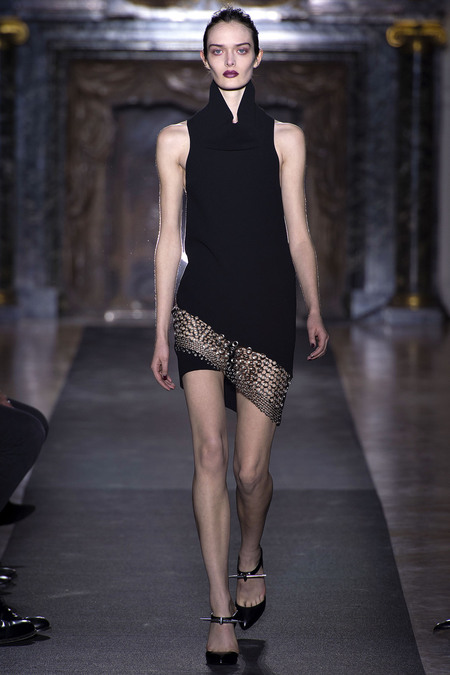
Overlapping with the last day of shows in Milan, the first day of Paris Fashion Week featured collections from primarily younger talents and smaller labels, the most promising of which was Anthony Vaccarello. His Fall collection was as sexy as always, but this time it left a little more to the imagination. Semi-fitted trouser suits with open shirts had an androgynous sex appeal, while loose blouses and angora knits softened fitted leather minis. Industrial metal hardware was constructed as mesh, used to best effect when used simply as raglan sleeves or narrow panels, straying into tasteless territory on gowns featuring Vaccarello's signature thigh-high slit. Wrap-around styles with complicated leather straps were sexy yet chic- a combination we hope the designer continues to perfect.


The big guns joined the show on day two, with Dries Van Noten presenting a collection that, for me, was heaven on earth. Dries has always been an expert at creating clothes that appeal to those with feminine and masculine tastes, this season inspired by the 1935 musical comedy Top Hat, with stars Ginger Rogers and Fred Astaire offering contradictions for the designer to mix. Fred was there from the start, in tailored grey trousers, navy peacoat and collegiate stripes, when Ginger creeped in with statement necklaces, crystals, fringing and finally, feathers. A lot of the femininity has a masculine touch- some fringing was in fact frayed striped silk reminiscent of tie fabric, embellished dress had low waists, skirts were paired with mannish shirts and both oftentimes came worn over trousers. The feather embellishment replaced the fall trend for fur, starting off dainty, dotted with diamante on outerwear, developing into colourful pink and yellow evening wear, before growing in volume and winding itself around the body. Embroidery was another decorative element, bright yellow bloom covered sides of utilitarian shirting or marked the waists of pinstripe blazers. Dries gave us what we didn't know we wanted; inspiring, special, yet wearable pieces that begged the question why no one had thought of all this before?


Marco Zahini offered another variation of masculine and feminine over at Rochas, presenting forties and fifties silhouettes in Prince of Whales checks, tweeds and heavy wools. His palette was much paler, featuring duck egg blue, dove grey, moss green and fawn, with dashes of chartreuse and darker grey towards the end. The colours aged the collection, while the weight of the fabrics lessened its wearability- swirling circle skirts in thick wool could hardly be described as practical. Zahini obviously tried to take things away from being too 'pretty', accessorising with inverted heeled shoes that slowed the models, ballerina flats with heavy soles, as well as his take on the trend of Celine's rolled-up clutch, that unfortunately was so small that I wondered what you could possibly put in there. I will applaud Zahini on his use of faux fur that looked every bit as luxurious as other designers' offering, but without the guilt, something particularly important with the huge trend for animal skin in the fall shows so far.


From the forties to the future, where Nicola Formichetti of Mugler touched on the sixties, nineties and beyond in a collection inspired by air travel and the idea of time travel. The starting looks featured voluminous yet sculptural shapes that were strong on top, with skirts wrinkling where they shouldn't, and the lining slipping below the hem on the opening look. There were experimental construction ideas in luxurious fabrics that would have made for interesting development but creativity faltered in the dresses that morphed into a disjointed style of awkwardly-draed silks atop 80's printed jersey. I would venture to attribute the opening looks to womenswear designer Sébastien Peigné, who perhaps looked back on his time working alongside Nicolas Ghesquire at Balenciaga, making me wonder if the odd juxtaposition of styles in the 27 looks is down to two designers sharing the bow at the end of the show.


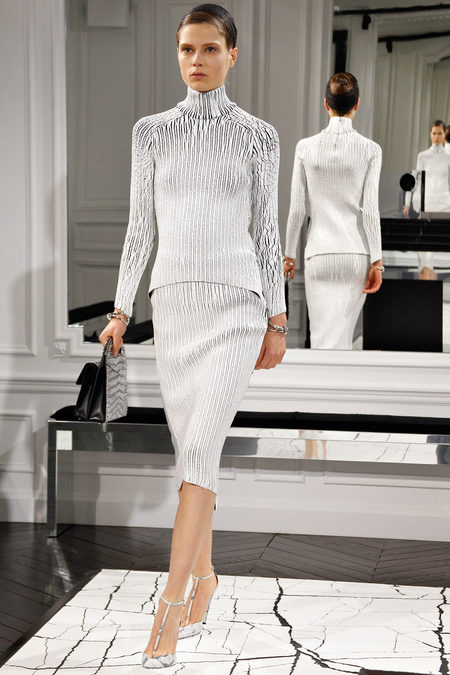
The third day of shows in Paris began with the most anticipated show of the season- Alexander Wang's debut at Balenciaga. Study of the archives was evident in the curved shoulders and rounded hips that dominated the silhouette, its sculptural effect strengthened by the power of a monochrome colour palette. The cut was simple and intelligent like that of Cristobal Balenciaga, but what many seem to have forgotten in the Wan hysteria, is that the celebration of this construction in the heyday of its founder was that it was new, unlike fashions before it. Wang used fabrics to bring ingenuity to his catwalk, where painting ribbed knits, burnt out velvet and print mimicked marble. Knotted silver wrapped around models' wrists, waists and ankles, in what looked a lot like the barbed wire jewellery and belts from Rodarte's Fall collection. It was a beautiful collection nonetheless, but a more timid debut than I expected, and one wonders if Wang intentionally didn't push the boat out in an effort to capture simplicity, or simply because he couldn't rise to the ultimate challenge that comes with taking over a Paris fashion house- going outside his comfort zone.


A designer mixing things up is Guillaume Henry at Carven, who gave gave his signature kooky prettiness a graphic edge with a heavy dose of zebra print this season. It came as print and jacquard, some incorporating rubber like the show invite, with print also appearing as a spotted fawn- an animal print I don't think we've seen before. The 1950's, off-the-shoulder, fitted dresses that walked down the Prada runway were seen here too, with the glowing highlight print that could be mistaken for blurred florals also looking quite Prada-esque. Fitted knits in criss-cross patterns and oversized outerwear in fuzzy pastels will be the sure sellers in another quirky but wearable collection.


This month saw Irish designer, Sharon Wauchob, present her eighth show at Paris Fashion Week. She presented a collection of easy elegance, its inspiration of ballet dancers referenced not literally, but in the quiet control and delicate touches. Waists were low, skirts and trousers long and loose, paired with slashed necklines or tops with fabric casually tied around the waist, like ballet dancers after practice. Light wools, gleaming silks, fine fringing and delicate lace lent to gliding movement, offset by textured wools and heavy furs, with dainty gold beading and intricate embroidery adding some finer details.


Rick Owens' menswear collection last month saw a softer touch, which seeped into his womenswear offering, something you wouldn't guess from the theme of 'Battle-scarred Heroism' that Owens' referenced. Like their male counterparts, the models' hair was windswept across their faces as they emerged from billowing steam on the runway, stomping on leather boots with needle-sharp stiletto heels, a change from the label's usual chunky soles. Coats were long like the t-shirts and tunics they were layered over, many donning relatively simple sheepskin collars, detail creeping in with the duffel coats and their tribal closures. Owens' study of traditional basket weaving took to leather panels, connected with leather stitching, growing in size until they looked like knots, then becoming finer in strands woven through coats purely for aesthetic reasons. The Japanese influence was more apparent in the graphic black and white looks, with fawn being the only other colour, in what was a refined yet very much signature Rick Owens collection.


Ballet dancers reappeared as inspiration for Peter Copping's romantic collection for Nina Ricci. The dancers' ways of layering garments could be seen in a jacket's collar tied like sleeves around a waist, coats over leotards for a rather risque walk home from dance class. The models were as slender as the designer's muse, which led to some bustier shapes looking a little loose and the drape over the bust often seemed a bit messy. Save for that, it was a beautiful collection- Copping brought sophistication to the girly touches with luxurious fabrics- a parka edged in fur, evening dresses belted with a string of ostrich feathers, hems dancing with ruffles of pleats and lace.


For Fall, Alber Elbaz tossed themes and inspirations aside and looked to why he does what he does, why fashion exists. To be worn and to be enjoyed, of course. The answer created a collection of beautifully-made clothes, accessorized with fun and rebellion- almost literally with chunky gold chains with medallions creaming HELP! and COOL. Garments for every occasion walked down the runway- a perfectly-fitted bustier cocktail dress, tartan skirt suits, sturdy leather bags, ruffled blouses, tailored trousers, glamorous gowns, trusty leather brogues and glittering dancing shoes. Quality set them apart, an issue clearly in Elbaz's mind in his use of exposed seams, flattering silhouettes and luxurious fabrics. Elbaz's playful personality gave the whole collection character- the oversized bug brooches, chiffon blooms, costume jewellery, all coming together to form a winning combination.


Meanwhile, over at Roland Mouret, fun was off the menu, the designer looking to the steely strength of Parisian women as inspiration. The clothing was certainly well-fitted, how the French like it, but I thought the bold colour blocking a little garish to be thought of as chic. Zebra knit jacquard crept in, followed by leopard as shoulders widened- perhaps referencing Mouret's other inspiration of Catherine Deneuve in 1983 vampire movie The Hunger, but there was little evidence of Deneuve's style and elegance here.


The elegance Christian Dior was known for was resurrected on the Dior catwalk, touched with the growing influence of Raf Simon's more eclectic taste. For his couture collection, the two designers' love of gardens was the inspiration, and this time Simons looked to their shared interest in art, using Andy Warhol's illustrations throughout the collection. They appeared on on bags and dresses, placed haphazardly on the latter like a scrapbook or mood board, described by Simons as 'memory dresses'. He used his artistic eye to turn Dior's beloved classic houndstooth into a graphic print, as well as blowing traditional knit up in proportion for dramatic ruffles. The unexpected layering of garments in his couture collection continued here, with waistcoats over bustier dresses, moulded together by the curved hips of both. Simons' mastery of couture shapes and masterful drape is something that sets him aside from the other designers that have recently taken over great Parisian fashion houses like Balenciaga. He is accomplished at all elements of fashion design, skilful at putting his own spin on the label's legacy and takes advantage of the skilled team he has at his disposal, and his Fall collection was a testament to that.


Another house that has lost its founder is Maison Martin Margiela, its collection designed by an anonymous team, secretive like the man they seek to emulate. The show started off with an ode to Margiela's take on tailoring- slightly surreal with oversized cuffs like the sleeves were growing off the wrist, necklines knotted like ties. it was interesting to watch the development unfold but it felt a little overworked in quantity- the maroon pinstriped looks needn't have been shown. Messy knit atop fine mesh and organza followed, ranging from pretty in red and pink to abstract curves directing their way around the torso, to purely messy. The seemingly unconnected range of concepts continued floor length dresses emblazoned with 'defile' down the side, but with all of the ideas floating around, it was hard to interpret what the collection meant as a whole.


Examining strength and fragility inspired Haider Ackermann's collection this season. Designer's refreshed respect for traditional fabrics was evident, with heavy wools, buttery leather, silk velvet and linens all present, given an earthy tone with brown python, exposed seams and frayed edges.  Ackermann's skill in construction was more classical and wearable this season, seen in elegant draped necklines, jackets falling easily off the shoulder, blouses falling open to the navel- all worn with an air of nonchalance. Leather belts tightly wrapped around the waist created a flattering silhouette but many of the oversized outerwear pieces were simply unflattering. Fur was used for the first time, in weaker pieces that must have been created purely to attract a new customer, but Ackermann's thought for commercial appeal applied to the whole collection, making it one of his most wearable yet.